
What one bad week taught us about software supply chain risk
Authors
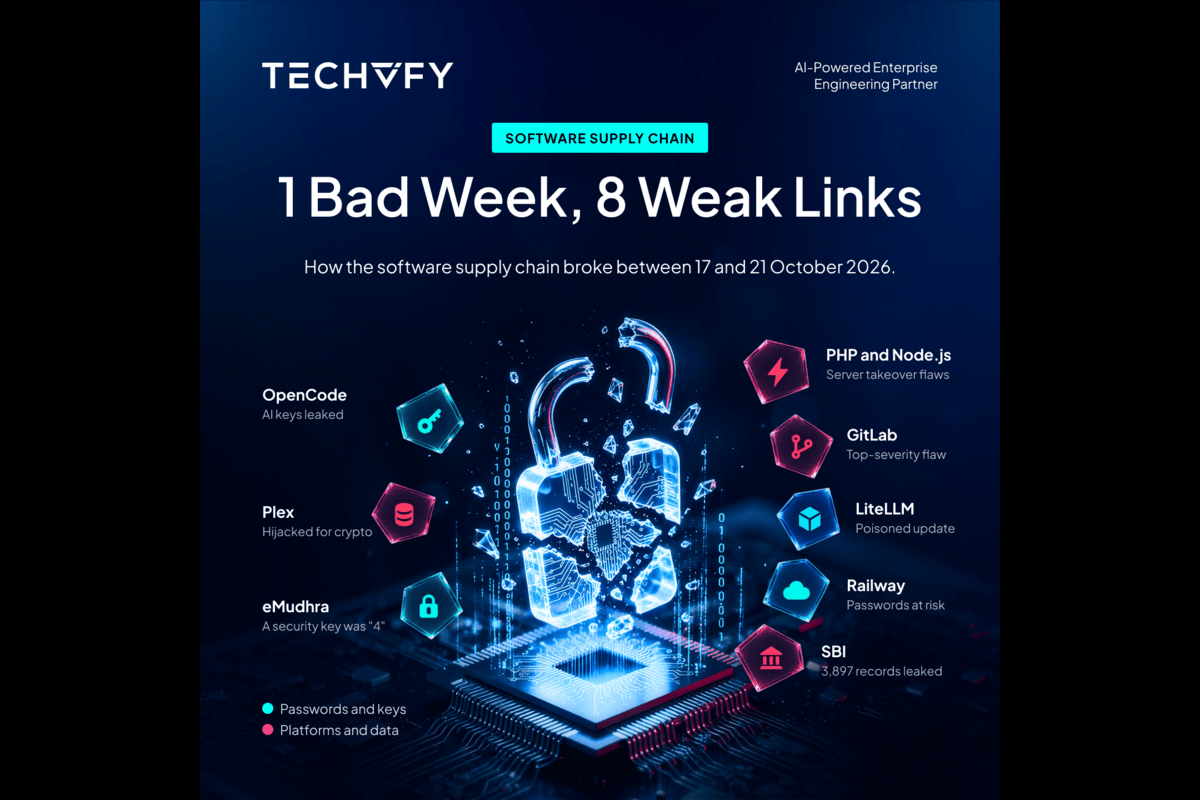
Between 17 and 21 October 2026, eight separate security incidents hit the tools and services that modern software is built on. A hosting platform, two AI developer tools, a certificate authority, three widely used software platforms, a media server and a bank all made the news within five days. PHP2Shell drew most of the attention, yet it was only one link in a longer chain.
Taken one by one, each incident looks like its own story. Seen together, they show how much of a company's security now depends on code, keys and services that sit outside its own systems. This article walks through what happened, what the incidents had in common, and what teams can check while the details are still fresh.
Eight incidents in five days
The table below lists each incident, when it surfaced, and where the weak point sat. Dates refer to when the incident was disclosed or first reported, which is not always when it began.
| Date | Incident | What happened | Where the weak point sat |
|---|---|---|---|
| 17 Oct | OpenCode | Attackers broke into an older part of the OpenCode Console. AI provider keys saved by 1.4% of Console users were exposed, and some users reported unauthorized charges on their OpenAI, Anthropic and Google accounts. | Keys stored in a third-party tool |
| 17 Oct | Plex | Attackers chained four flaws in Plex Media Server, and early attacks installed cryptocurrency miners. CISA warned of active exploitation and set US federal agencies a 23 October deadline to patch. | An internet-facing application |
| 17 Oct | eMudhra | Eight of the certificate authority's signing keys could be calculated from public certificates, and one of them was the number 4. Chrome, Firefox, Apple, Microsoft and Android blocked the affected certificates on 19 and 20 October. | The trust behind website certificates |
| 21 Oct | PHP (PHP2Shell) | Two critical flaws let attackers run code on web servers without logging in. Fixes shipped in PHP 8.2.35, 8.3.36, 8.4.27 and 8.5.12, while PHP 7.4 to 8.1 received no official release. | A language runtime under most websites |
| 21 Oct | Node.js (Node2Shell) | A high-severity flaw in the compression library bundled with Node.js was fixed in versions 22.23.4, 24.22.1 and 26.12.1. Node.js 20 is end of life and gets no fix. | A bundled third-party component |
| 21 Oct | GitLab | GitLab fixed a flaw rated CVSS 10.0, the highest possible score, affecting self-managed installations back to version 7.0 from 2014. It followed a separate 10.0 fix on 12 October. | The platform that stores company code |
| 21 Oct | LiteLLM | Release 1.107.0 of this popular AI library shipped with code that stole cloud credentials, SSH keys and AI provider keys. It stayed on PyPI for about 1 hour 41 minutes, long enough for roughly 49,000 downloads. | A trusted update channel |
| 21 Oct | Railway | The hosting platform found that someone may have accessed the environment variables customers stored with it, in some cases decrypted. Every user was told to replace their stored keys and credentials. | Secrets held by a supplier |
| 21 Oct | SBI | A preliminary review by State Bank of India found 3,897 customer records with personal information on the dark web. The source of the leak has not been stated. | Unknown |
The weak point usually belonged to someone else
Very few of these incidents required a direct attack on the companies that ended up exposed. Railway customers did nothing wrong, yet every one of them had to replace their stored credentials. OpenCode users lost money through keys they had saved in a tool they trusted. Website owners relying on eMudhra certificates had no way to know the keys behind them were guessable.
Half of the eight incidents, Railway, LiteLLM, OpenCode and eMudhra, came down to passwords and keys held outside the affected company's own codebase. That matters because most security reviews start with a company's own systems, while a growing share of its risk lives in the platforms, packages and services it depends on.
Trusted updates can deliver the damage
The LiteLLM incident is a useful example of why "keep everything up to date" is not a complete strategy on its own. The malicious version arrived through the project's normal release channel, so teams that installed the latest version automatically received the stolen-credential code as well. According to Wiz, harvested cloud credentials were used within hours.
Updating quickly is still the right default for security fixes, as PHP2Shell showed. The lesson is to know which updates flow into production on their own, and to have a way to check or pause them when a widely used package behaves unexpectedly.
Old versions have no safety net
Several of the week's fixes stopped at a cut-off line. PHP 7.4 to 8.1 received only basic source backports from the PHP project, Node.js 20 received no fix at all, and the GitLab flaw reached back to releases from 2014. Systems on those versions cannot simply be patched in an afternoon.
The next cut-off is close. PHP 8.2 reaches end of life on 31 December 2026, after which it will stop receiving security fixes. Teams still running older internal portals, plugins or vendor tools on these versions face a choice between upgrading, isolating the system, or taking it offline until it can be updated, which is the course CISA advised for PHP 8.1 and earlier.
The gap between a fix and an attack is short
PHP released its fixes on 21 October, and SecurityWeek reported confirmed working attacks on 24 October. Plex flaws were already being exploited when they were disclosed. In both cases, the time available to find and update every affected system was measured in days.
That speed turns inventory into a security question. A team that already knows where each runtime and package is used can respond in hours, while a team that has to search across servers, containers and vendor tools often needs a week or more.
What teams can check now
None of the following requires new tools to start. Each one simply makes the next incident easier to answer:
- List the runtimes, frameworks and versions in production, including containers, plugins and vendor appliances.
- Record which outside services hold your passwords, keys and tokens, and who can replace them.
- Note which dependencies update automatically and how you would pause them if a release looked wrong.
- Track end-of-life dates for the software you run, starting with PHP 8.2 on 31 December 2026.
- Keep a software bill of materials (SBOM), a list of every component inside each build, so checking for an affected version becomes a lookup.
A clearer view of what you depend on
None of these incidents was exotic. Most came through ordinary channels: a stored key, a routine update, an old version nobody had replaced. That is what makes the week worth remembering, since the same channels exist in almost every organisation that builds or runs software.
The most useful outcome of a week like this is a clearer picture of what your systems rely on, who holds which keys, and which versions are running out of support. With that picture in place, the next advisory becomes much easier to read.
If you would like help building that picture, Techvify is offering a free consultation and exposure check covering dependencies, secrets and keys, pipelines and AI-agent access. You can request your exposure check here.
Facts verified on 28 October 2026.
Sources
TechCrunch: OpenCode breach · BleepingComputer: Plex2Shell · The Next Web: eMudhra certificate keys · Tenable: PHP2Shell FAQ · SecurityWeek: PHP2Shell exploitation · CISA: PHP alert · Aikido: Node2Shell · The Hacker News: GitLab CVSS 10.0 flaw · Wiz: LiteLLM compromise · BleepingComputer: Railway · Moneylife: SBI data leak