
How To Check Your Software Supply Chain Exposure in Practice
Authors
When CISA added both PHP2Shell flaws to its Known Exploited Vulnerabilities catalog on 26 October 2026, its advice to organisations started with a simple instruction: inventory every system running any version of PHP, then patch it or take it offline. For many teams, that first step turns out to be harder than the patch itself, because PHP and the components around it are spread across hosting panels, containers, vendor tools and projects nobody owns anymore.
This guide walks through how to check your exposure in practice, from building the inventory to deciding what to fix first and what to do with systems that cannot be updated. The same approach works well beyond PHP, since most of the incidents in October reached companies through dependencies, stored keys and build tools as well as through runtimes.
Why the inventory comes first
Every later decision depends on knowing what you run. Censys estimated that around 10 million of the 42 million PHP services it could see on the internet had been patched by 27 October, according to The Record, which leaves a very large number of systems on affected versions. In most organisations, the systems still unpatched are the ones missing from the list rather than the ones a team chose to leave alone.
A useful inventory goes beyond a list of servers. It records which runtime and version each system uses, which libraries it pulls in, which passwords and keys it holds, how it gets built and deployed, and which tools or AI agents have access to it. With that in place, "are we affected?" becomes a lookup instead of a search.
Five areas to check
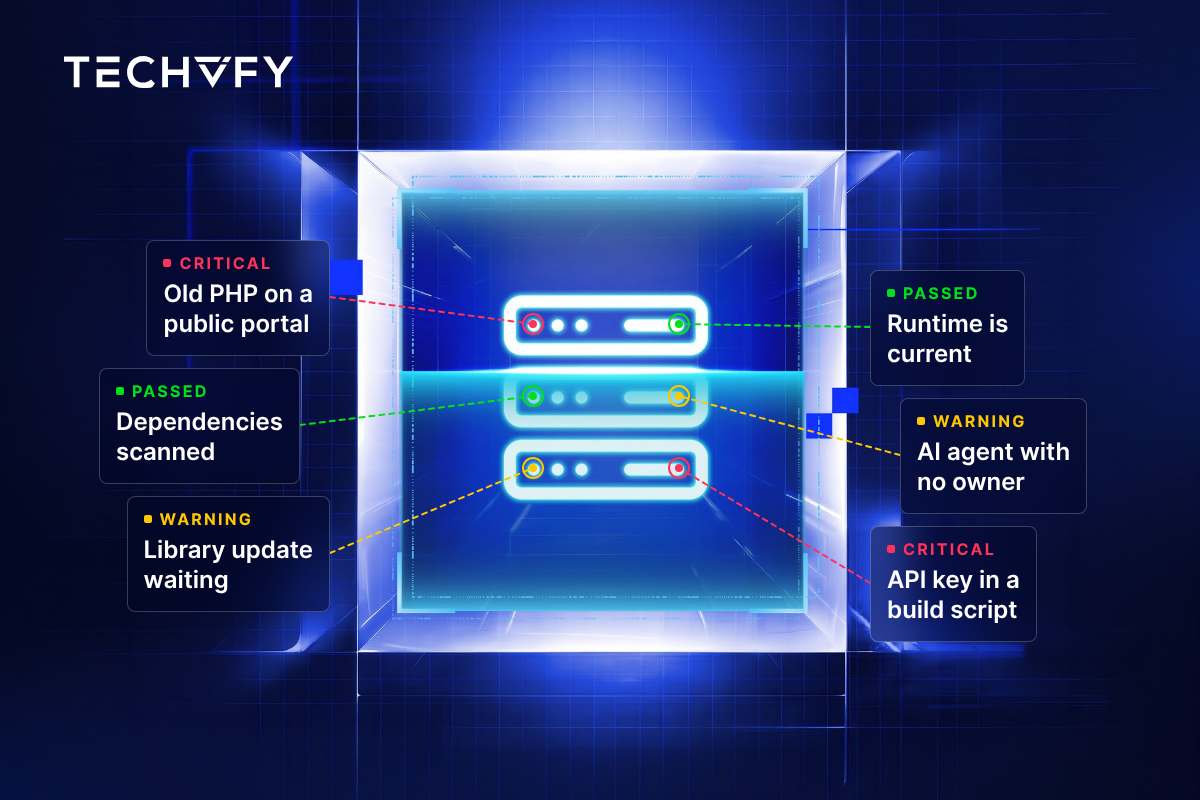
1. Runtimes
Start with the language runtimes behind your websites and applications: PHP, Node.js, Java, .NET, Python and others. Record the exact version on each system, including staging copies, old campaign sites and anything bundled inside a hosting control panel or vendor appliance. Check the running version on the server, since the version in a build file or ticket may not match what is actually live.
2. Dependencies
Most applications rely on far more third-party code than their own. Use your package manager's lock files or a dependency scanner to list every library and its version, then compare that list against known vulnerabilities. Pay attention to how updates arrive, since the LiteLLM incident in October showed that an automatic update from a trusted source can still carry harmful code.
3. Secrets and keys
List the database passwords, API keys, cloud credentials and tokens each system uses, where they are stored and who can replace them. Look for keys saved in code, build scripts or shared configuration, and for credentials held by outside platforms on your behalf. Because one PHP2Shell flaw can expose server memory, any secret on an unpatched, internet-facing system is safer treated as known to someone else.
4. Pipelines
Your build and deployment pipeline decides what reaches production, so it belongs in the check. Note which steps scan code and dependencies, which credentials the pipeline holds, and whether container images are rebuilt when a base image or runtime is fixed. An image built before a patch keeps the old version until someone rebuilds and redeploys it.
5. AI agents with access
AI coding assistants and agents often receive API keys, repository access or cloud permissions to do their work. Record which agents exist, what each one can reach, and which keys they hold. The OpenCode breach in October, where saved AI provider keys were exposed, is a reminder that these keys are worth the same care as any other production credential.
Ranking what you find
A first check usually turns up more issues than a team can fix in a week, so the order matters. A severity score describes how bad a flaw could be, while real exposure depends on whether the affected system faces the internet, whether the vulnerable code path is actually reachable, and what the system can access if it is compromised.
Known exploitation is a strong signal for the top of the list. CISA's Known Exploited Vulnerabilities catalog records flaws with evidence of active attacks, and PHP2Shell joined it within a week of the fix. Issues that are exploited, reachable from the internet and close to sensitive data or keys belong at the top, while unused or unreachable components can wait for routine updates.
When a system cannot be patched
Some systems run versions that will not receive an official fix, such as PHP 7.4 to 8.1 in this case. For these, CISA advises taking the system offline until it can be updated. Where that is not possible, isolating it from the internet or placing it behind a VPN reduces the risk while an upgrade is planned.
Upgrading an old system is safer when the team first records what it actually does: its business rules, permissions, data checks and edge cases. That record becomes a baseline the new version is tested against, so the rebuild closes the security gap while keeping the business running the way it should.
Closing the loop
A fix is only finished once it has been tested against the original problem. After patching or upgrading, confirm the running version, replace any keys that may have been exposed, and check logs from the date exploitation began, which for PHP2Shell means 17 October according to Amazon. Keeping a short record of each fix and its test result makes audits and customer questions much easier to answer later.
Keeping the picture current
An inventory starts going out of date the day it is finished, so the most durable step is to build it into the way software is made. A software bill of materials (SBOM) for each build lists every component inside it, and CISA publishes guidance on the minimum information an SBOM should contain. Combined with security checks on every merge request and build, it means the next advisory can be answered in hours.
PHP 8.2 reaches end of life on 31 December 2026, which makes now a practical time to run this check and plan upgrades for anything still on 8.2 or earlier.
If you would like help running this check across your own systems, Techvify is offering a free consultation and exposure check covering runtimes, dependencies, secrets and keys, pipelines and AI-agent access. You can request your free exposure check here.
Facts verified on 30 October 2026.
Sources
The Record: CISA adds PHP2Shell to KEV · The Hacker News: CISA confirms active exploitation · CISA: PHP alert · Tenable: PHP2Shell FAQ · Wiz: LiteLLM compromise · TechCrunch: OpenCode breach · CISA: Minimum elements for an SBOM