
Patched For PHP2Shell? Five Places You May Still Be Exposed
Authors
On 21 October 2026, PHP released fixes for two critical flaws now known as PHP2Shell. Most teams moved quickly and patched the servers they know well. The harder part of this incident sits elsewhere, in the copies of PHP that nobody thinks of as PHP because they arrived inside a control panel, a plugin, a container or a project that ended years ago.
PHP runs about 69% of websites whose server-side language is known, according to W3Techs, so most organisations have more of it than their server list suggests. This article covers why those forgotten copies matter, where they usually sit, how to find each one, and what to do with versions that will not receive an official fix.
Why the forgotten copies matter
Both flaws can be triggered by an attacker who has no login, and PHP rates Apache with mod_php as the highest-risk setup because a demonstrated exploit runs before any application code does. A plain page on a vulnerable version is exposed, and the security of the website built on top of it does not help. One of the two flaws can also expose memory, where passwords, API keys and session tokens live.
The window for acting is short. Amazon reported exploitation attempts on 17 October, before the fix was public, and SecurityWeek reported confirmed working attacks on 24 October. A copy of PHP that was missed during the first round of patching is now the most likely way in.
Five places PHP tends to hide
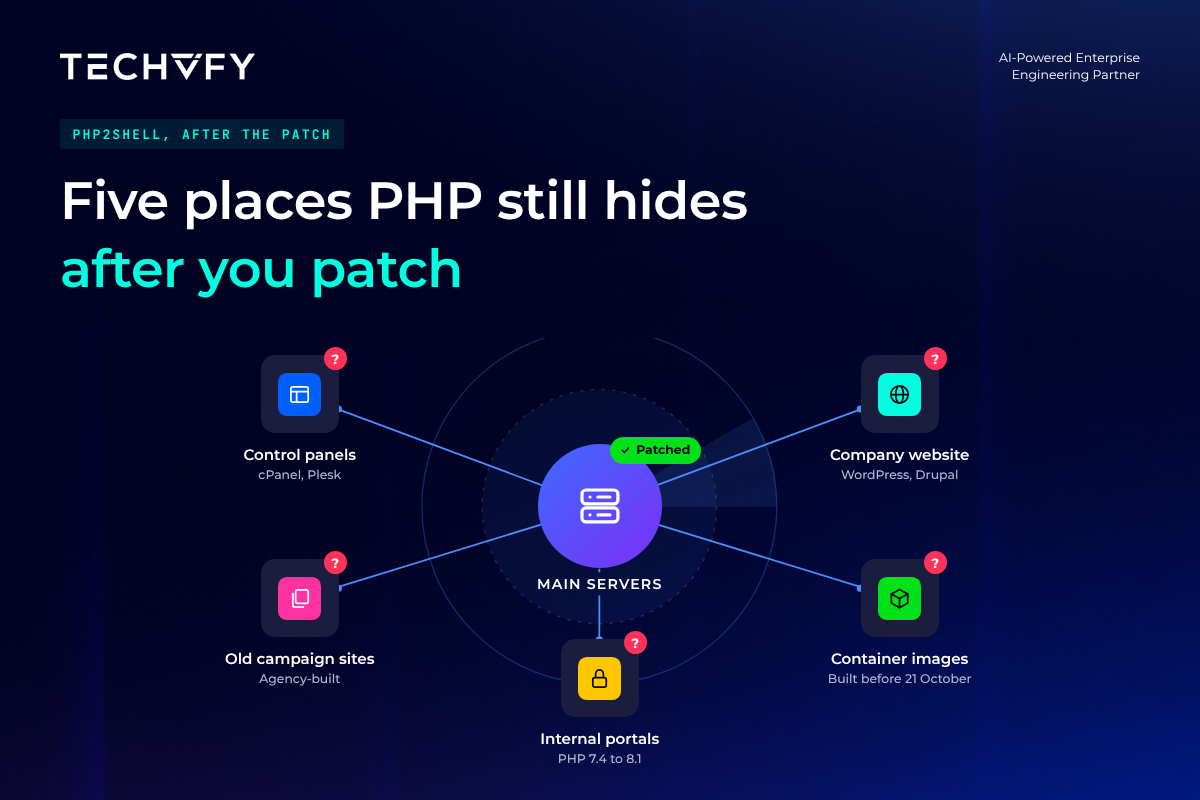
1. Hosting control panels and shared hosting
Security researchers list cPanel, Plesk and shared hosting accounts among the likely exposure points. On shared hosting, the PHP version is set by the provider, so updating your own application may not touch it at all. The quickest check is to ask your hosting provider or panel vendor which PHP build the panel and your accounts run, and when it was updated.
2. The company website and its CMS
WordPress, Drupal, Joomla and Magento all run on PHP, and researchers confirmed the attack working against specific versions of each. Updating the CMS itself is not the same as updating PHP underneath it. Confirm the PHP version on the server that hosts the site, including any staging or test copies that are reachable from the internet.
3. Old campaign sites and microsites
Event pages, product launch sites and landing pages built by an agency often stay online long after the campaign ends. With no clear owner, they rarely receive patch alerts. A practical way to find them is to list every domain and subdomain the company still pays for, then check which ones still serve content and who is responsible for each.
4. Container images built before 21 October
Patching the host server does not change what is baked into a container image. Any image built before the fix still carries the old PHP, and running containers keep it until they are rebuilt and restarted. Rebuild every PHP-based image created before 21 October, redeploy it, and confirm the running version rather than the version in the build file.
5. Internal portals and vendor tools on older PHP
Admin dashboards, intranet tools and appliances supplied by vendors often run older PHP that nobody has touched in years. These are the copies most likely to sit on PHP 7.4 to 8.1, which will not receive an official release. Ask vendors directly whether their products bundle PHP and when a fixed version will ship.
Which PHP versions are fixed
| PHP version | Status |
|---|---|
| 8.5 | Fixed in 8.5.12 |
| 8.4 | Fixed in 8.4.27 |
| 8.3 | Fixed in 8.3.36 |
| 8.2 | Fixed in 8.2.35. Reaches end of life on 31 December 2026 |
| 7.4 to 8.1 | No official release. The PHP project published basic source backports only |
| 5.4 to 7.3 | End of life, no fix from the PHP project |
Linux distributions and long-term support vendors received patches in advance, so packaged PHP may carry a fix under a different version number. Check your distribution's security advisory before assuming a server is unpatched.
If you cannot upgrade yet
PHP published interim settings that reduce exposure, such as disabling session upload progress and adjusting memory limits, followed by a restart of all PHP workers. PHP is clear that these are not a complete fix, and updating remains the only full protection. Cloudflare also deployed web application firewall rules, which it describes as a stopgap that only covers traffic routed through Cloudflare.
For systems that cannot be updated, or that run PHP 8.1 or earlier, CISA advises taking them offline until they can be patched or upgraded. Where that is not possible, isolating the system from the internet, or placing it behind a VPN, is the next best option while an upgrade is planned.
After patching, check what may have leaked
Because one flaw can expose memory, it is safer to assume that secrets on an unpatched, internet-facing server were readable. Replace database passwords, API keys and session secrets used by those systems, starting with the ones that grant the widest access.
Amazon recommends starting any investigation from 17 October. Researchers suggest exploitation is most likely to show up as unusual processes started by PHP, such as shells, download tools or reconnaissance commands launched from the web server, so web server and PHP logs from that date onward are the place to look.
Making the next advisory easier
Every step above depends on knowing where PHP runs, which versions are in use, and which secrets each system holds. Teams that keep an up-to-date inventory of runtimes and dependencies, ideally as a software bill of materials (SBOM) for each build, can answer "are we affected?" with a lookup rather than a search across servers and vendors.
PHP 8.2 reaches end of life on 31 December 2026, so the same inventory is worth using now to plan upgrades for anything still on 8.2 or earlier.
If you would like help finding where PHP runs across your systems, Techvify is offering a free consultation and exposure check covering runtimes, dependencies, secrets and keys, pipelines and AI-agent access. You can request your exposure check here.
Facts verified on 29 October 2026.
Sources
Tenable: PHP2Shell FAQ · Huntress: PHP2Shell rapid response · SecurityWeek: PHP2Shell exploitation · Unit 42: Threat brief · CISA: PHP alert · BleepingComputer: PHP emergency patches