
Why Vietnam? The Case for AI-Augmented Engineering
Authors
Ask anyone planning enterprise software where the next decade of engineering capacity will come from, and Vietnam enters the conversation quickly, trailed every time by the same careful question: can a team there really carry production systems for a company on the other side of the world? What plays above is the short answer; the longer one begins just below.
Why Vietnam for AI-augmented engineering
Vietnam earned its place in global software the unglamorous way, through two decades of delivery work for companies that measure everything. That history matters now more than ever, because AI-augmented engineering is demanding in a specific direction: it needs engineers senior enough to direct machines and review their output, and a talent pipeline wide enough to keep producing them.
Vietnam holds both in depth: Marvell operates its third-largest R&D centre worldwide here, global engineering employers keep widening their local footprint, and the generation now entering the industry picked up AI tooling as a native skill rather than a retraining exercise. When agents write a growing share of the code, the scarce resource becomes judgment, and judgment is what a deep, seasoned engineering base supplies.
Why Vietnam is getting strong in AI consulting
Consulting strength comes from having done the thing, and Vietnam's AI practice has been forced to grow up fast. The country's national AI law has been in force since March 2026, which means teams here treat governance, auditability and model accountability as a legal requirement at home rather than a workshop topic. Advising a European or American enterprise on AI readiness lands differently when your own production systems already live under a regulator.
The consulting ladder that enterprises actually climb, from readiness and strategy through governed pilots to scaled deployment, is being walked daily by Vietnamese teams shipping applied AI into real operations. Advisory work increasingly starts here rather than ending here, because what clients find is experience lived rather than licensed, available at Vietnamese cost structures and awake across most of the world's working hours.
Which brings us to Techvify
We are one of the companies this environment produced. Techvify today runs more than 500 engineers, the large majority at mid-level and senior grades, serving over 15 Fortune 500 and Global 2000 organizations, and our client retention has held at 95 percent, which we consider the only compliment that compounds. We run the practice on ISO 27001 and ISO 9001 certifications, keep our controls mapped to SOC, GDPR and CSA expectations, and add governance guardrails of our own so the AI we ship stays auditable. We also sit inside the AI Verify Foundation, the Singapore-based nonprofit whose open-source framework helps organizations test AI systems for fairness, safety and accountability.
More telling than the credentials is the delivery model they protect. AI sits inside every phase of how we build, from early discovery through development, agent-driven testing and release, and across our engagements that compounds into deliveries up to 40 percent faster. Our commercial models then make sure the gain lands where it should: we charge for outcomes, so when AI shortens a build, the difference shows up on the client's side of the ledger.
Six words, tested on camera
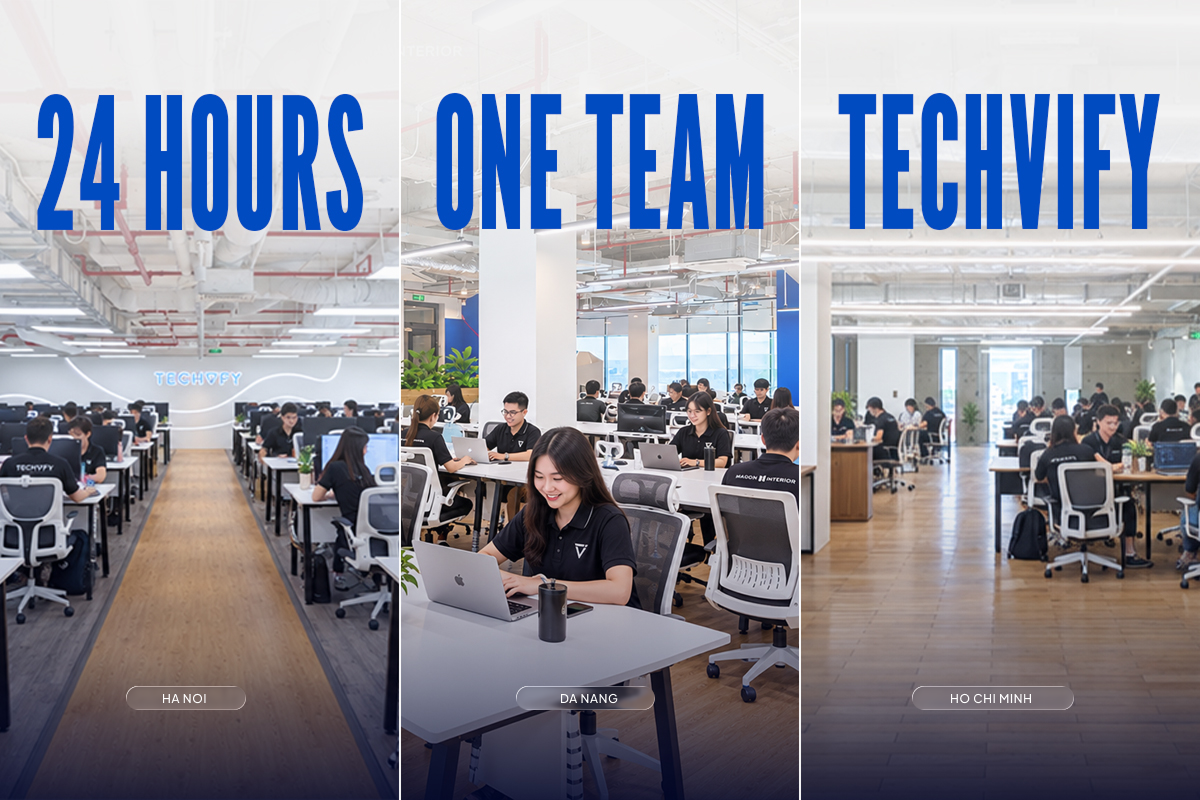
Our tagline says AI in Motion. Built for Enterprise. Taglines are cheap to write and expensive to mean, so we let one ordinary night of our work settle the difference: agents carrying tasks through the dark, people reviewing what the machines produced before the sun reaches our clients.
The same terms govern the night above and every Techvify engagement: work priced on what it delivers, reviewed by people who answer for it, and handed over each morning further along than it was left the evening before. Which is the whole promise, in the end. You don't buy hours, you wake up to progress.