Waterfall Process in Offshore Software Development

Loading...
The TECHVIFY Team is a group of experienced professionals passionate about technology and innovation.
The Waterfall process was one of the earliest and simplest ways to put together a software development process. It was called “Waterfall” because of the order of phases.
Each step in a Waterfall process flows into the next like a waterfall’s cascading tiers. No phase begins until the prior phase is complete, and each phase’s completion is terminal. The only way to revisit a phase is to start over at phase one.
In other words, the Waterfall management method is a sequential, linear project management process consisting of several discrete phases.
The Waterfall process’s goal is to deliver the full system at once. This method was mainly suitable for large enterprises or government systems. However, due to the large scope it has to handle, the Waterfall process was slow, unmanageable, and not very responsive to changes.
The Waterfall process usually consists of five to seven phases that follow in strict linear order. The specific names of the phases vary, but they were originally defined by their inventor, Winston W. Royce, in the following way:
Learn more: Scrum vs. Waterfall: What’s The Difference?
Patrick Rockwell, an expert in this field, mentions situations where the Waterfall process can be beneficial:
“Though less common these days, when your end product’s requirements are fixed time and money yet are variable, choose the method.
I like to imagine a scientist doing research for a big company—through trial and error, he’ll likely restart his whole process many times and at different stages to get the coveted final result.
Through Waterfall project management, this behavior is anticipated and even preferred! This enables members to adjust and re-think their approach time and time again.”
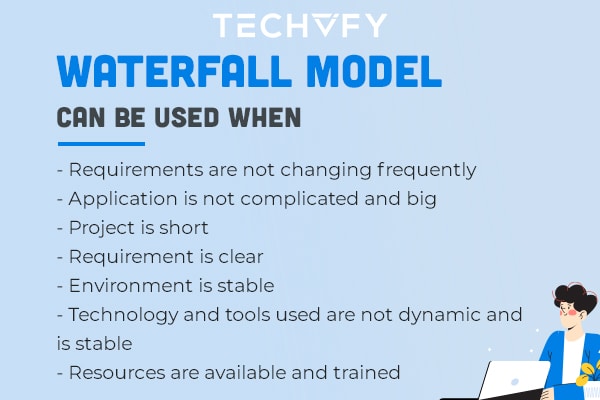
As Patrick mentions, the Waterfall process can be problematic if the project requirements are not perfectly clear. Because of its inability to adapt to change, the Waterfall methodology works best for short projects with clear requirements.
If your requirements are not constantly changing and your environment is stable, Waterfall is an ideal choice. Thus, the Waterfall process is also adequate when your technology and tools are stable.
That’s a basic introduction to the Waterfall software development method. To sum up, the Waterfall method can help you accurately estimate your project cost, resources, and deadlines if you have a fully laid out project schedule with detailed requirements and specifications.