Types of NoSQL Databases: Standout Features and Real-life Applications

Loading...
The TECHVIFY Team is a group of experienced professionals passionate about technology and innovation.
In the rapidly evolving world of data management, understanding the various types of NoSQL databases is essential. These databases, often called “Not Only SQL,” have gained prominence for their ability to handle large volumes of unstructured and semi-structured data. In this article, TECHVIFY will explore the diverse landscape of NoSQL databases, exploring each type’s unique characteristics and applications.
NoSQL, or “Not Only SQL”, refers to a database class that does not use the traditional relational database model. NoSQL databases can deal with large amounts of unstructured and semi-structured data, becoming famous for web applications, social media applications, and real-time data processing applications.
NoSQL databases offer several advantages over relational databases, including:
Please feel free to contact us for a free consultation: Data Engineering
Regarding NoSQL databases, diversity is the name of the game. Each type has unique characteristics and strengths, making it suitable for specific use cases. Let’s discuss the different types of NoSQL databases to gain a deeper understanding.
Document-based databases, such as MongoDB and Couchbase, store data in semi-structured documents using formats like JSON or BSON. What sets them apart is their flexibility in data representation. Each document can have different fields, making them adaptable to evolving data structures.
Features
Applications
Redis and Riak exemplify that key-value stores store data as simple key-value pairs. They are known for their simplicity and speed. In this model, the key is a unique identifier for the associated value.
Features
Applications
Column-family stores, including Apache Cassandra and HBase, organize data into columns and column families, resembling a table structure. They excel at storing and retrieving large volumes of data.
Features
Applications
Graph databases, as seen in Neo4j and Amazon Neptune, represent data as nodes and edges. This structure facilitates the efficient representation of complex relationships.
Features
Applications
Manage your data with TECHVIFY:
Relational and NoSQL databases are different types of databases used for other purposes.
Relational databases are the traditional type of database and are based on the relational model. Relational databases save data in tables with fixed rows and columns. Each row displays a record, and each column shows a field. Relational databases manage data using the structured query language SQL, which allows you to perform complex queries on your data, such as joining tables and filtering results.
When to use relational databases:
On the other hand, NoSQL databases do not have a fixed schema. They can keep data in various formats, such as key-value pairs, documents, columns, and graphs. NoSQL databases are often used for scalability, performance, and flexibility applications.
When to use NoSQL databases:
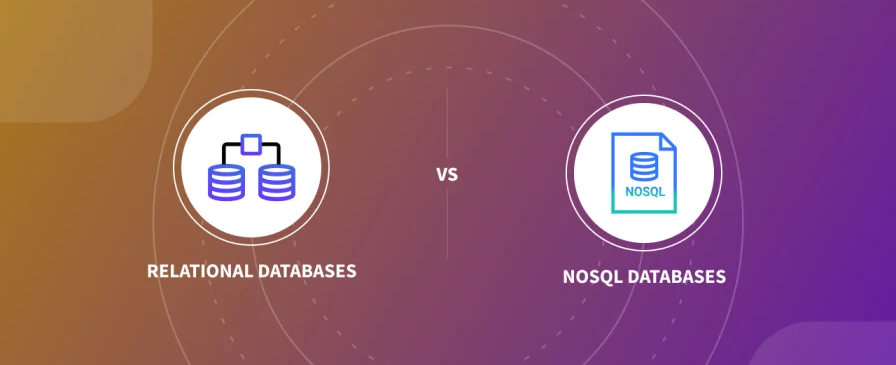
Critical Differences Between Relational and NoSQL Databases
| Feature | Relational Databases | NoSQL Databases |
|---|---|---|
| Data Model | Fixed schema | Flexible schema |
| Query Language | SQL | NoSQL-specific query languages |
| Scalability | Vertical scaling (adding more resources to one server) | Horizontal scaling (adding more servers) |
| Performance | Good for complex queries | Suitable for simple questions and large datasets |
| Flexibility | Limited flexibility | High flexibility |
In conclusion, NoSQL databases have completely changed how data is managed. They are perfect for various applications, from real-time data processing to online and social media platforms, because of their scalability, throughput, and adaptability. Consider document stores for semi-structured data, key-value stores for simplicity, column-oriented databases for large amounts of data, and graph databases for complex relationships when choosing a NoSQL database type.

There are four main types: key-value stores, document stores, column family stores, and graph databases.
According to DB-Engines, MongoDB is the most popular NoSQL database, which tracks the popularity of over 200 database systems. It is a document-oriented database that stores data as JSON documents. MongoDB is known for its scalability, performance, and flexibility. It is a good choice for many applications, including web applications, mobile applications, and real-time data processing systems.
No, MySQL is a relational database. Relational databases save data in tables with fixed rows and columns. MySQL suits applications that keep complex data relationships and perform complex queries.