What is Business Intelligence and Its Use?

Loading...
The TECHVIFY Team is a group of experienced professionals passionate about technology and innovation.
Business Intelligence (BI) is a crucial discipline that helps businesses understand their operations and competitive landscape. It encompasses both internal and external analysis, enabling companies to track competitors’ activities while identifying potential challenges.
How does your company turn collected data into meaningful insights that provide a competitive edge?
The field of business intelligence often involves ethical considerations, requiring careful navigation between corporate objectives and legal boundaries.
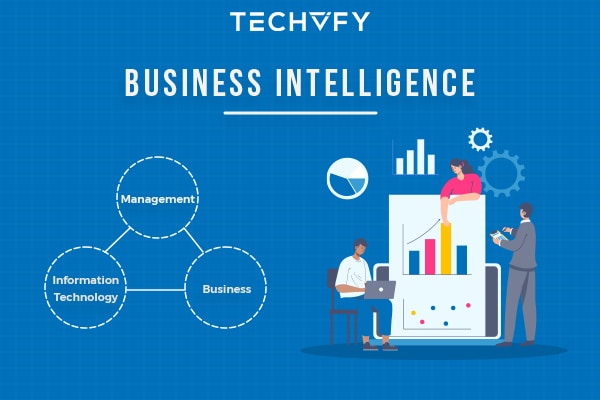
Business Intelligence utilizes specialized software and services to transform raw data into actionable insights for strategic decision-making. BI tools analyze comprehensive datasets, presenting findings through reports, dashboards, charts, and interactive visualizations that reveal key business metrics.

Business Intelligence empowers organizations to make informed decisions by contextualizing current and historical data within their business framework. Analysts leverage BI to establish performance benchmarks, streamline operations, and identify market opportunities that can enhance revenue. When implemented effectively, BI supports diverse business functions from regulatory compliance to workforce optimization.
Cindi Howson, Gartner Research Vice President, notes that BI applications extend beyond conventional metrics like sales growth and cost reduction. She highlights how Ohio’s Columbus school system successfully employed BI tools to analyze attendance patterns and academic performance, ultimately improving student outcomes and graduation rates.
Key BI applications that demonstrate its value:
Learn More On:
BI systems employ Extract, Transform, Load (ETL) processes to aggregate structured and unstructured data from multiple sources. This data is standardized and consolidated into centralized repositories for comprehensive analysis.
Data mining techniques automatically analyze datasets to identify meaningful patterns and outliers. BI solutions incorporate various analytical approaches including:
BI reporting transforms complex findings into intuitive visual formats including:
By contextualizing real-time and historical data, BI enables organizations to swiftly transition from insight to action. This supports both immediate operational adjustments and long-term strategic improvements across supply chains, customer service, and market positioning.

As BI technology continues advancing alongside business needs, organizations must stay informed about emerging trends. The integration of AI and machine learning is expanding BI capabilities, enabling more sophisticated predictive analytics and automated insights.
Cross-functional data sharing and collaboration initiatives will grow as organizations pursue data-driven transformation.
Advanced visualization techniques will become increasingly vital for cross-departmental communication and decision-making.
BI adoption continues expanding across industries including retail, insurance, and energy, enabling real-time sales tracking, customer behavior analysis, and profitability forecasting. BI platforms constantly evolve through technological innovation and creative applications.
This fundamental BI capability, also called ad hoc querying, allows users to investigate specific business questions through custom queries. While initially created for immediate needs, valuable queries are often incorporated into regular reporting cycles.
As one of the original BI technologies, OLAP enables multidimensional data analysis for complex calculations. Modern implementations allow direct querying of columnar databases, eliminating the need for pre-built OLAP cubes.
OI delivers real-time analytics to operational staff, supporting immediate decision-making. Applications range from call center problem resolution to logistics optimization, helping organizations address issues as they emerge.
This specialized BI domain analyzes geographic data through map-based visualizations. LI informs critical decisions including: