Nearshore Vs. Offshore: Which Is Right For Your Business?
Author
The TECHVIFY Team is a group of experienced professionals passionate about technology and innovation.
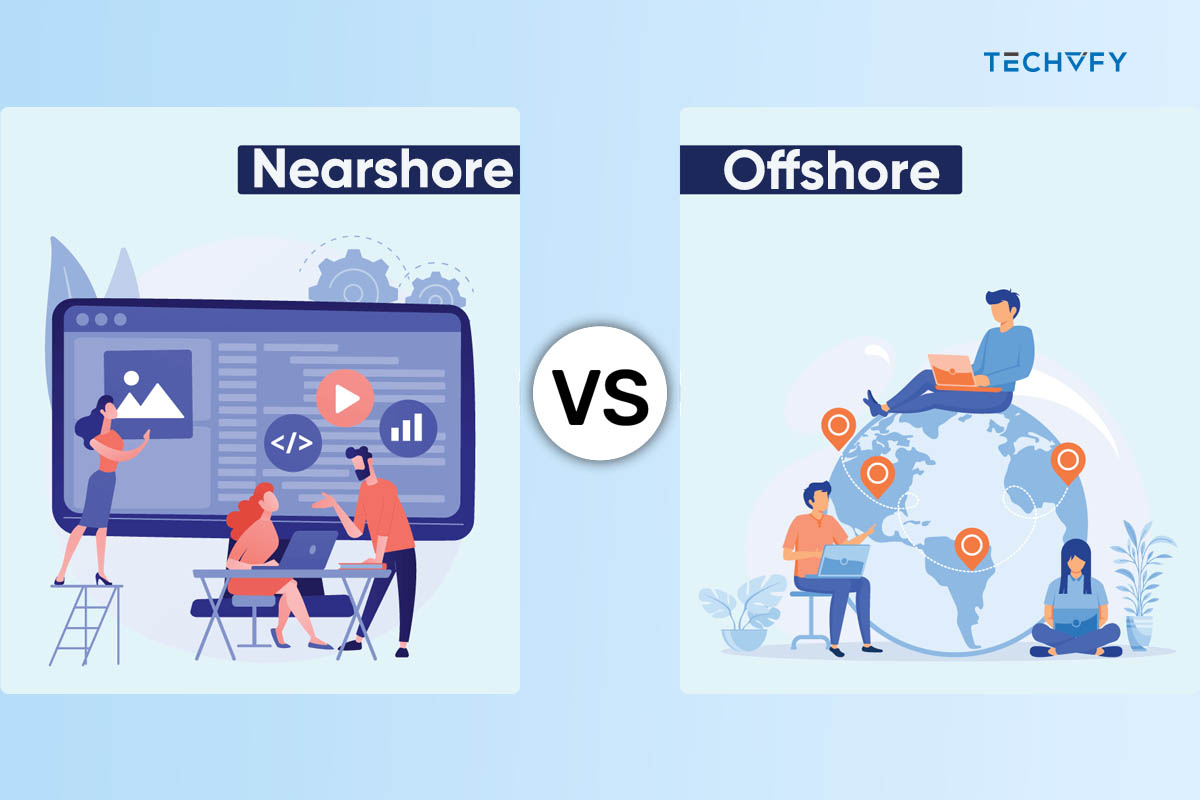
You might have had a negative experience with outsourcing software development or be considering it for the first time. Many businesses choose between Nearshore and Offshore outsourcing, particularly for software development. This article compares Nearshore vs Offshore outsourcing models to help you decide which is best for your business.
I. Overview of Offshore & Nearshore Outsourcing
1. What is Offshore Outsourcing?
Offshore outsourcing involves a company hiring a team in a distant country to perform tasks. This team can be part of an offshore company or an independent freelancer providing the required services. For instance, a US company might primarily collaborate with teams in the Vietnam or India to reduce costs, as these teams often charge less.
However, working with offshore teams involves challenges including major differences in time zones and cultural variations, which can complicate communication and teamwork. Despite these issues, many businesses find the financial savings justify dealing with these obstacles.

What’s good and what’s not:
Good:
- Affordable: Lower costs in developing economies allow significant savings, e.g., 80% in Vietnam compared to the US and Canada.
- Expansive Talent Pool: Large number of skilled developers in emerging markets, with countries like Vietnam adding 20,000 tech specialists annually.
- Acquiescence: Developing countries offer flexibility to international clients, facilitating quick project starts and providing comprehensive legal support.
Not Good:
- Reduced Control with Offshoring: Offshoring limits your project control and complicates providing detailed feedback. You may need to adjust your schedule to communicate with your offshore team.
- Travel Challenges to Offshore Locations: Longer flights are longer to fly from the US to Asia than to Latin America. Expect overnight journeys for offshore trips.
Check out our articles about Offshore Development:
Offshore Delivery Center: The Definitive Guide
Offshore Staff Augmentation: The Modern Solution to Hiring Challenges
2.What is Nearshore Outsourcing?
Nearshore outsourcing involves moving customer service tasks to professionals in neighboring countries. This model often features little to no time difference, which helps in better communication and efficient workflows. For instance, companies in the United States might choose Mexico or Brazil for their outsourcing needs.
This outsourcing approach also strengthens professional relationships. Managers and executives can travel easily between headquarters and the outsourced locations. This proximity allows for direct training of outsourced supervisors and staff. Moreover, employees at these locations tend to adopt the company’s goals, culture, and project management styles more effectively.
What’s good and what’s not:
Good:
- Cultural Similarities: Teams understand your language and goals, simplifying product development.
- Time Zone Convenience: Similar time zones allow easier scheduling and quick emergency responses.
- Ease of In-person Visits: Geographical closeness makes face-to-face meetings and inspections convenient
Not Good:
- Lower Competition: Nearshore regions often have less competition compared to offshore hubs. High competition can lead to a client-oriented approach and reasonable deadlines
- Maturing Nearshore Markets: Nearshore markets are developing. Offshore options are more common, but finding specialized nearshore partners can be tough.
Looking To Setup An Offshore Delivery Center?
Get in touch with’s experts for a free consultation. We’ll help you decide on next steps, explain how our ODC process is organized, and provide you with a free estimation.
II. Nearshore vs Offshore Outsourcing: The Complete Comparision
While both nearshore and offshore outsourcing involve working with teams in other countries, there are important differences that can affect which option is better for your business needs.
1. Geographic Proximity and Time Zone Alignment
| Nearshore Software Development | Offshore Software Development |
|
|
Proximity and Time Zone
Nearshore software development takes advantage of being geographically closer to your company, usually sharing the same or a similar time zone. This closeness allows for synchronized working hours, making collaborating and communicating easier. For instance, if you need a quick update or must adjust a project swiftly, the nearshore team is just a quick video call or a message away.
In contrast, offshore software development typically involves larger time differences. Although this can be managed, it often delays responses and necessitates strict scheduling. For a U.S. company working with a team in Asia, the time difference means when one team finishes their day, the other is just starting. This can delay the work process, particularly when quick feedback or decisions are needed.
Impact on Work Efficiency
The difference in time zones influences daily communications and project timelines. While some businesses can manage these challenges, others find them a major inconvenience, especially in settings that demand quick decision-making and flexibility, such as agile project environments.
Mapping of Outsourcing Regions
Nearshore outsourcing typically involves teams in countries with the same or nearby time zones. For U.S. companies, this often means partnering with countries in Latin America. Conversely, offshore outsourcing generally means working with teams in regions with significant time differences, like Asia, complicating scheduling and ongoing project cooperation.
2. Cultural Affinity and Communication
| Nearshore Software Development | Offshore Software Development |
|
|
Nearshore outsourcing generally provides a better cultural fit, enhancing communication and collaboration. This improves the speed and quality of project progress and outcomes.
3. Cost Differences
| Nearshore Software Development | Offshore Software Development |
|
|
Nearshore and Offshore outsourcing are often chosen because they are cheaper than onshore hiring or outsourcing. Offshore development typically offers lower rates for positions such as architects, developers, or QA engineers, making it a good option for saving money.
In summary, both options provide substantial savings compared to onshore services.
4. Access to Talent
Tech talent is emerging worldwide.
Both nearshore and offshore outsourcing provide access to a global talent pool.
Offshore outsourcing lets you tap into growing software development markets like Vietnam. The IT services market in Vietnam is expected to grow by 9.34% (2024-2029) to reach a market value of $3.11 billion by 2029. This growth will lead to more tech talent in the country and the region.
Ultimately, your success with outsourcing and accessing talent depends on the partner you choose.
III. Offshore vs Nearshore: When to Use.
Offshore Outsourcing
- Cost Savings: When the primary goal is to reduce costs significantly, as offshore regions often have lower labor costs.
- Specific Skill Sets: If the required skills are available primarily in distant regions due to specialized labor pools.
- 24/7 Operations: For round-the-clock productivity by leveraging different time zones.
- Scalability: When rapid scaling requires access to a larger workforce not available locally.

Nearshore Outsourcing
- Proximity: When close collaboration or frequent travel between the client and provider is crucial due to geographical proximity.
- Cultural Similarities: When cultural alignment is needed for better communication, understanding, and reduced time zone differences.
- Language: If sharing a common language is important to prevent miscommunication.
- Data Security/Regulations: For compliance with similar regional data security regulations.
Ultimately, the decision will depend on the specific business objectives, the nature of the project, and the desired level of collaboration and communication.
IV. Nearshore vs Offshore: The Perfect Choice for You
1. Define the Needed Expertise
Many countries offer software development outsourcing. Consider what industry expertise and skills your team needs. This will help narrow down the list of potential countries. Check international rankings like TopCodes and SkillValue to find the countries with the required skills. Popular outsourcing destinations include:
2. Explore Potential Companies
After selecting the country or countries to outsource to create a list of promising vendors and research them carefully. Review the industries they specialize in, their company culture, case studies, and customer reviews. Confirm that their past projects align with your project scope. Ask for developer CVs after a call with company representatives.

3. Stay in Touch
Clear communication is crucial for outsourcing success. Poor communication is responsible for 25% of project failures. With a nearshore team, scheduling regular meetings is easier due to minimal time differences. For offshore teams, plan communication well to ensure at least 1-2 overlapping working hours. Use a world clock planner to set up regular meetings.
5. Learn the Culture
Offshore outsourcing may involve cultural and language barriers. According to the UK’s National Outsourcing Association, 75% of surveyed respondents would pay more attention to culture in the future. Make sure there are no significant differences in organizational culture with your vendor, and ensure you share a common language.
Conclusion
Nearshore and offshore outsourcing each have distinct advantages and challenges. Due to geographical proximity, nearshoring offers better cultural alignment and collaboration, while offshoring provides cost savings and access to a broader talent pool. Your decision should align with your project’s specific needs and communication preferences.
Choose TECHVIFY for offshore outsourcing that drives growth and efficiency. With our proven expertise, we’ll deliver cost-effective, tailored solutions to accelerate your business success. Contact us now and transform your outsourcing strategy.
TECHVIFY – Global AI & Software Solution Company
From Startups to Industry Leaders: TECHVIFY prioritizes results, not just deliverables. Accelerate your time to market and see ROI early with high-performing teams, AI (including GenAI) Software Solutions, and ODC (Offshore Development Center) services.
- Email:[email protected]
- Phone:(+84)24.77762.666