
David Ho Promoted to Chief Technology Officer at Techvify
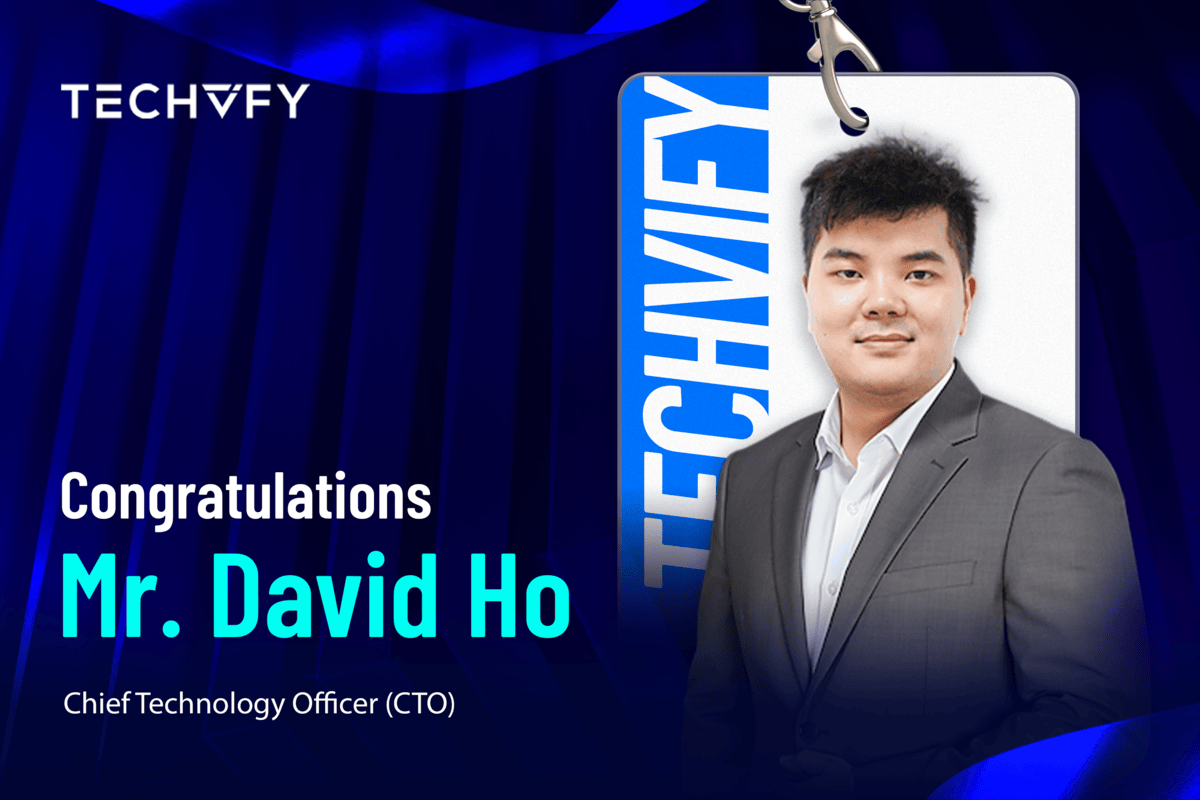
Every good system needs an architect. So does a company.
David Ho has been promoted to Chief Technology Officer at Techvify. He has moved up through a series of key positions inside the company, each one wider than the last, and takes on the role with more than 12 years in software engineering behind him.
For the companies we build for, the more useful question is not what the title changes. It is what a promotion like this one signals about how Techvify intends to work over the next few years.
A path built inside the company
Early on, the unit of work was a component. Build the thing, make it correct, make it fast.
In solution architecture the unit became the whole system, and with it a harder discipline: hearing past a brief to the problem underneath it. Clients rarely arrive with a description of their actual constraint. They arrive with a request, and the request is usually already a guess at the solution. Getting that distinction right early is worth more than any amount of engineering skill applied later.
By his most recent role the frame had widened again, to the decision itself. Where should an enterprise's technology be heading. What deserves investment now, what can wait, and what should be retired rather than modernised. Those questions get settled before anyone opens an editor, and the answers set the ceiling on everything built afterwards.
Each of those steps happened here. That matters more than it might sound, because it means the person now setting technology direction has already lived with the consequences of the direction Techvify set before.
The combination that makes the difference
David has advised enterprises of every size on technology direction, IT modernisation, and the delivery of Cloud, AI, Data Platform and Automation. What makes that range work is a combination rarer than it sounds: architectural thinking, deep business understanding, and enough practical experience to tell an elegant design from one that will actually earn its keep.
His enterprise architecture work gets judged on whether it is secure, adaptable and durable, and then on whether it moves the numbers a client reports to their own board. Growth. Cost. Competitiveness. Architecture that satisfies the first test and fails the second is a diagram, not a decision.
What changes for clients
As CTO, David owns the long-term technology strategy behind Techvify's shift to an AI-Powered Enterprise Engineering Partner. Three parts of that mandate matter most to the companies we work with.
- Stronger R&D, so the capability we bring to a project arrives ahead of the project rather than being assembled during it.
- AI established as a core capability across our service ecosystem, rather than a specialism bolted on when a client asks for it.
- Solution development standardised to international benchmarks, so that quality becomes a property of how Techvify works rather than of which team you happen to be assigned.
That third point is the one clients tend to care about most, and it is the hardest of the three to fake. Consistency at scale is not something a company can claim. It shows up in the second project, and the fifth.
The harder problem
Ask David what the difficult part of the job is and the answer is not the architecture. It is the alignment. Technical problems yield to enough thought. Getting a group of capable people genuinely aimed at the same objective is the one that stays hard, and it is the part most leaders underestimate.
That view matters more to clients than it first appears. Delivery consistency is not really a process question. It is a question of whether the people doing the work share an understanding of what good looks like, which is why an engineering organisation can hold its standard across teams it has never staffed together before.
The same disposition shows up outside the day job. David teaches at universities including FPT University, which fits a longer pattern of raising the level around him rather than being the smartest person in the room.
What comes next
Promotions like this one are worth pausing on. Techvify's technology direction now sits with someone who has spent his career moving from components to systems to strategy, and who did that moving here. He knows what we can build, because he built a good deal of it.