AI in Wealth Management: Smarter Investments, Less Risk
Loading...
The TECHVIFY Team is a group of experienced professionals passionate about technology and innovation.
Wealth and asset management firms have been early adopters of innovative technologies, with many integrating AI in wealth management to enhance efficiency and decision-making. However, the use of AI for processing large and complex unstructured data is still evolving.
AI offers significant potential in information search, retrieval, and synthesis, as well as in content generation across text, images, and code. Its ability to process massive datasets, provide context-aware insights, and generate human-friendly responses is reshaping business strategies. As a result, executives are exploring how AI and wealth management solutions can transform value chains, enhance enterprise positioning, and create long-term value for stakeholders while making a lasting impact on society.
PwC’s 2023 Global Asset and Wealth Management Survey highlights a rapidly evolving industry shaped by consolidation, market volatility, and technological disruption. A key trend is the rise of AI-driven robo-advisors, with assets under management expected to nearly double to $6 trillion by 2027.
Beyond robo-advice, firms are increasingly integrating AI use cases in wealth management, such as AI-driven trading strategies, unstructured data analysis, and back-office automation. To stay competitive, industry leaders should:
These strategies define the future of asset and wealth management—tech-forward, customer-centric, and adaptable across diverse asset types.
Learn More On:
Artificial intelligence (AI) is revolutionizing wealth management by enhancing decision-making, automating repetitive tasks, and delivering personalized client services. With AI-driven insights and automation, wealth managers can work more efficiently, helping clients make smarter financial decisions with ease.
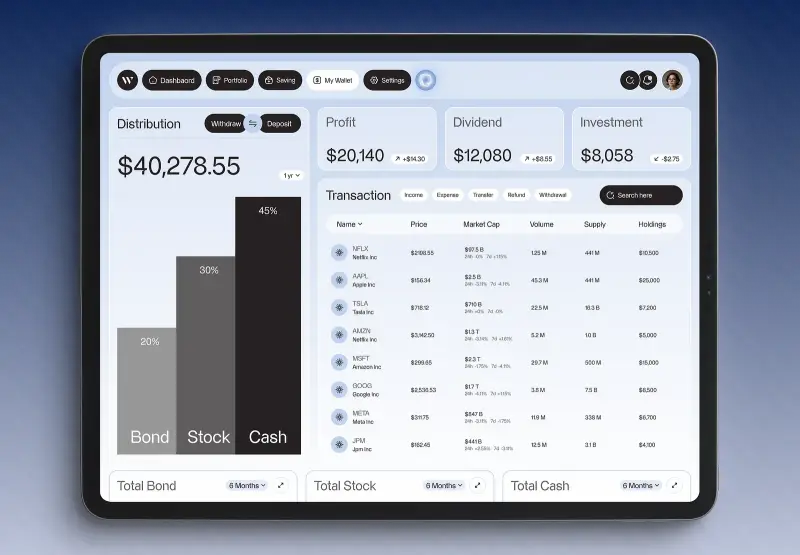
AI and wealth management
AI in wealth management is powered by several key technologies that work together to improve efficiency, accuracy, and client interactions.
Machine learning continuously improves by analyzing data, identifying patterns, and making predictions. In wealth management, this capability allows firms to make better investment decisions and manage risks more effectively.
Have a Project Idea in Mind?
Get in touch with experts for a free consultation. We’ll help you decide on next steps, explain how the development process is organized, and provide you with a free project estimate.
AI is transforming how wealth management firms operate, improving efficiency, enhancing client relationships, and streamlining internal processes.
AI is transforming how wealth management firms operate by improving efficiency and reducing the time required for data analysis. Financial information that once took hours to process can now be analyzed in seconds. This allows advisors to make quicker, more informed investment decisions. AI-powered systems detect market trends and risks with greater accuracy, helping firms stay ahead of potential challenges. Automation also reduces the time spent on administrative tasks, enabling staff to focus on strategic planning and client interaction.
AI is changing the way wealth management firms interact with clients by making financial services more personalized and accessible. Advanced analytics help firms track client behavior and preferences, allowing them to provide tailored advice that aligns with individual financial goals. AI-powered digital platforms offer real-time access to investment portfolios, enabling clients to monitor their finances and make informed decisions anytime. Virtual financial advisors and chat-based AI assistants enhance customer support by providing immediate responses to inquiries. AI even plays a role in client retention by identifying early signs of dissatisfaction, allowing advisors to address concerns before they become major issues.
AI is streamlining back-office operations by automating complex and time-consuming tasks. Trade processing, client record updates, and financial reporting are now handled with minimal human intervention, improving efficiency and accuracy. AI-powered systems help detect errors in financial data, reducing compliance risks and ensuring regulatory requirements are met. Fraud detection has also improved, with AI monitoring transactions and identifying unusual activity in real-time. Compliance tracking has become more efficient, as AI keeps firms updated on regulatory changes without the need for extensive manual oversight. Additionally, AI-driven document management systems organize and store client records in a way that simplifies audits and reporting.
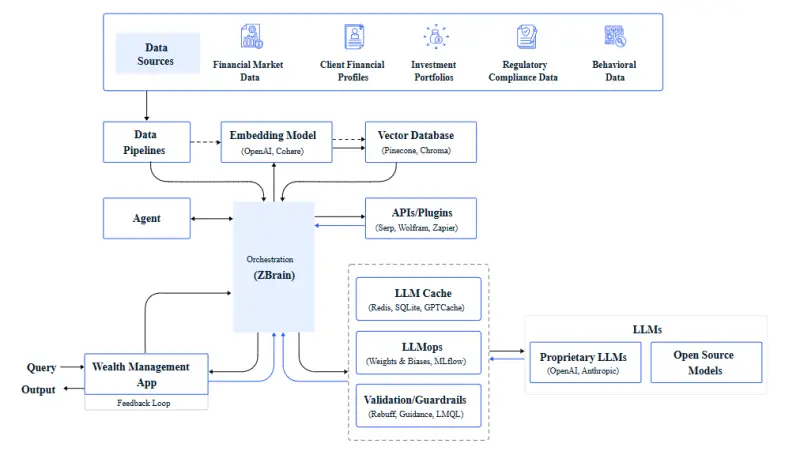
Artificial intelligence (AI) is revolutionizing wealth management by integrating advanced Large Language Models (LLMs) with an organization’s vast datasets. This approach enhances data analysis, generates deeper insights, and supports sophisticated decision-making processes.
AI in wealth management
Below is a step-by-step breakdown of how AI powers modern wealth management:
Wealth management relies on a wide range of structured and unstructured data sources:
This data is processed through data pipelines that handle ingestion, cleaning, and structuring, ensuring accuracy and usability for AI-driven analysis.
Once cleaned, the data is transformed into a machine-readable format using an embedding model, which converts text into numerical representations (vectors). These vectors are stored in a vector database (e.g., Pinecone, Weaviate, PGvector), allowing efficient retrieval and analysis.
Orchestration Layer
The orchestration layer manages the AI workflow, coordinating interactions between different components. Tools like ZBrain handle:
This ensures smooth execution of wealth management tasks.
APIs and Plugins
APIs and plugins (e.g., Serp, Zapier, Wolfram) extend AI capabilities by integrating financial tools, accessing external data sources, and automating specific tasks.
The AI system begins processing when a user submits a query related to investment strategies, risk assessment, or portfolio optimization.
Organizations can choose from various LLM APIs (OpenAI, Anthropic) or open-source models for AI execution. Hosting options range from traditional cloud providers (AWS, GCP, Azure) to AI-optimized platforms like Databricks and Mosaic.
Learn More On:
While AI offers many benefits in wealth management, it also introduces risks and challenges. To use AI safely and effectively, firms must address these concerns proactively.
AI systems are not perfect—they can make mistakes or develop biases, which may lead to poor investment decisions or unfair client treatment. Firms must carefully monitor AI-driven decisions, regularly testing and refining these systems to detect and correct errors.
AI also relies heavily on data, raising privacy and security concerns. Firms must protect client information, comply with data protection laws, and ensure they only collect and use the data that is truly necessary.
Another challenge is the complexity of some AI models, which can be difficult to explain. In finance, transparency is critical, as clients and regulators need clear reasons behind investment decisions. Firms should prioritize AI solutions that are interpretable and accountable.

Wealth management AI solutions
AI can analyze vast amounts of unstructured data, such as emails, social media posts, and news articles, to identify relevant insights. However, this data is often messy and unorganized, making it challenging to process accurately.
To address this, firms need strong data management systems that can clean, sort, and verify information. Poor-quality data can lead to flawed AI outputs, resulting in misguided investment strategies.
Natural language processing (NLP) tools can help AI extract key insights from large sets of text-based data. However, these tools require specialized training to accurately interpret financial terminology, ensuring the insights generated are meaningful and reliable.
Before fully adopting AI, firms should conduct small-scale tests—known as proofs of concept—to evaluate its effectiveness.
A proof of concept helps determine whether AI can deliver real value. It allows firms to identify potential issues early, addressing them before AI tools are deployed in live client environments.
Testing should assess AI’s ability to make sound investment decisions, its ease of use, and its acceptance among staff and clients. Ensuring that AI tools are intuitive and beneficial to both advisors and investors is essential for successful adoption.
While proofs of concept require time and investment, they help prevent costly mistakes down the line. By validating AI’s performance in controlled settings, firms can implement AI solutions with greater confidence and efficiency.
AI is redefining wealth management by enhancing efficiency, decision-making, and client experiences. From automated portfolio optimization to AI-driven compliance solutions, firms that integrate AI can improve operational performance and gain a strategic advantage in a rapidly evolving market.
TECHVIFY specializes in AI development for wealth management, helping firms implement tailored AI solutions that drive efficiency, accuracy, and scalability. Contact us today for a free consultation and explore how AI can streamline operations, optimize investment strategies, and enhance client services.
TECHVIFY – Global AI & Software Solution Company
From Startups to Industry Leaders: TECHVIFY prioritizes results, not just deliverables. Accelerate your time to market and see ROI early with high-performing teams, AI (including GenAI) Software Solutions, and ODC (Offshore Development Center) services.