
Inside Techvify | Episode 2: A Day With Our AI-Augmented Engineering Team
Authors
Inside Techvify continues with a look at how our teams actually build. In Episode 1, Business Analyst Cadie showed how we prepare our people for 2026 and beyond, from hands-on AI training to English as a daily working language. Episode 2 moves from preparation to practice and opens up the execution side of AI-Augmented Engineering, a discipline we apply to how we plan, build and ship.
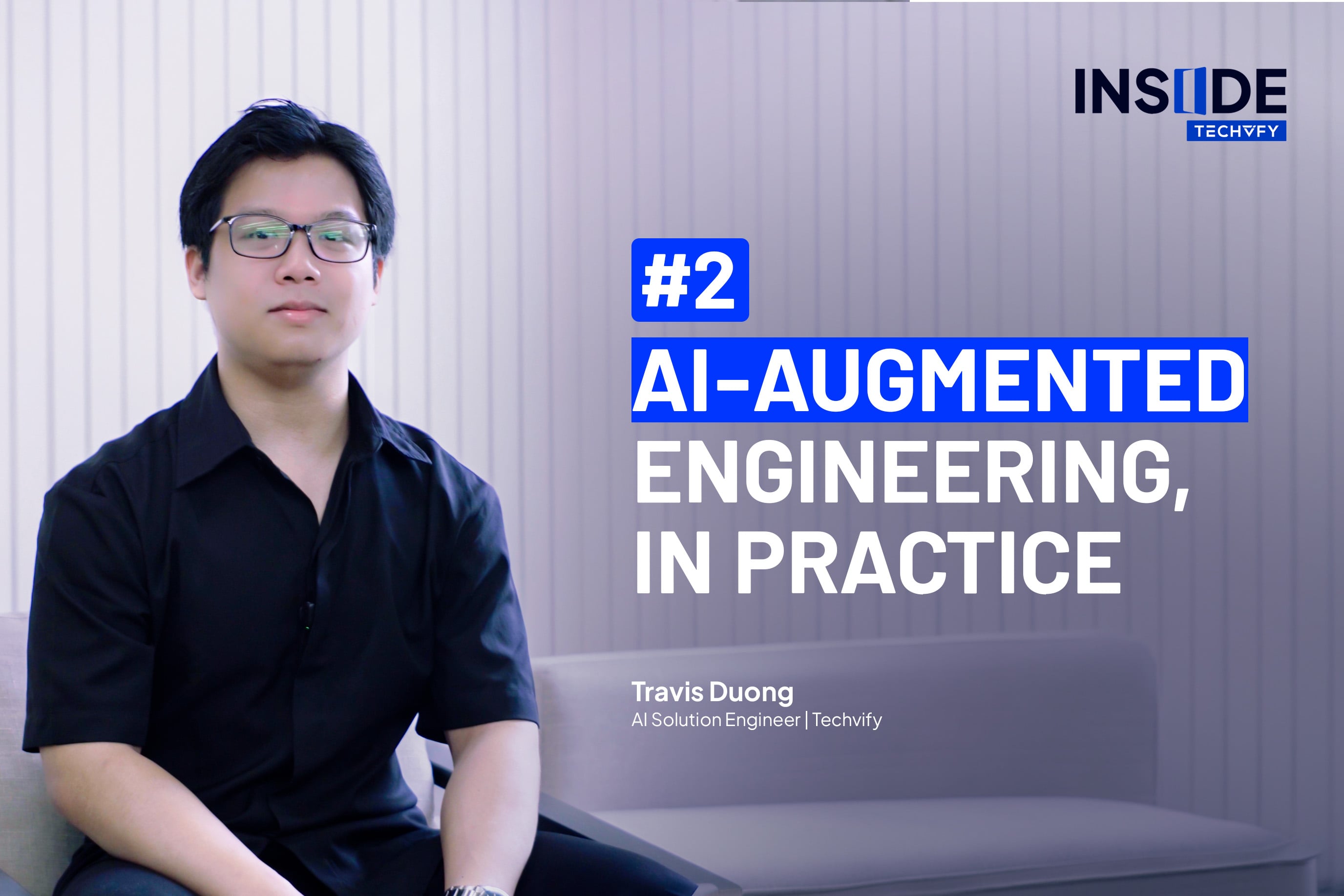
Our AI Solution Engineer Travis walks us through a working day with the AI-Augmented Engineering team, covering how a feature takes shape, who does what once AI agents are involved, and the checks that keep the output reliable.
Where Every Feature Actually Begins
Before any code is written, AI helps shape a living spec: structured requirements that both engineers and agents can act on. Much of the work is settled before anyone touches the keyboard.
This step matters more once agents are part of the team. An agent builds from what it is given, so a vague request produces vague output, and the cost of that shows up later as rework. A structured spec gives the agents a clear brief and gives the engineers a fixed reference to review against. It also cuts out much of the back-and-forth that slows a traditional team, where questions surface mid-build and travel between people before anything moves.
The Tiny Team Era in Practice
Small teams of engineers work alongside AI agents that take on the routine implementation. That changes what the engineers spend their day on. Our engineers act as architects who set the direction, reviewers who check what the agents produce, and integrators who fit the pieces into a working system.
Every piece of AI-generated work is reviewed by an engineer before it moves on. The agents add speed and volume, while the judgment calls, such as how the parts connect and whether a change is right for the product, stay with people who understand the system as a whole.
The Guardrails Behind the Speed
Faster output only helps if it can be trusted, and AI-generated code brings its own risks. Travis addresses them directly, and the answer is a set of checks that run as part of the workflow:
- Every AI-generated change passes automated evals before it is accepted.
- Prompts are versioned like code, so a change in how an agent is instructed can be tracked, reviewed and rolled back.
- Regression tests run against real production scenarios on every release, so new work cannot quietly break what already runs.
AI multiplies what the team can do, and the guardrails make that output safe to ship.
What This Means for Our Clients
Put together, the spec, the engineers and the guardrails give each engineer more leverage on every project. For clients, that means delivery that moves faster without giving up accountability, and a team that can commit to an outcome with confidence.
Less hype and more discipline is what AI-Augmented Engineering means to us. Want to see what this could look like for your team? Get in touch with Techvify.